
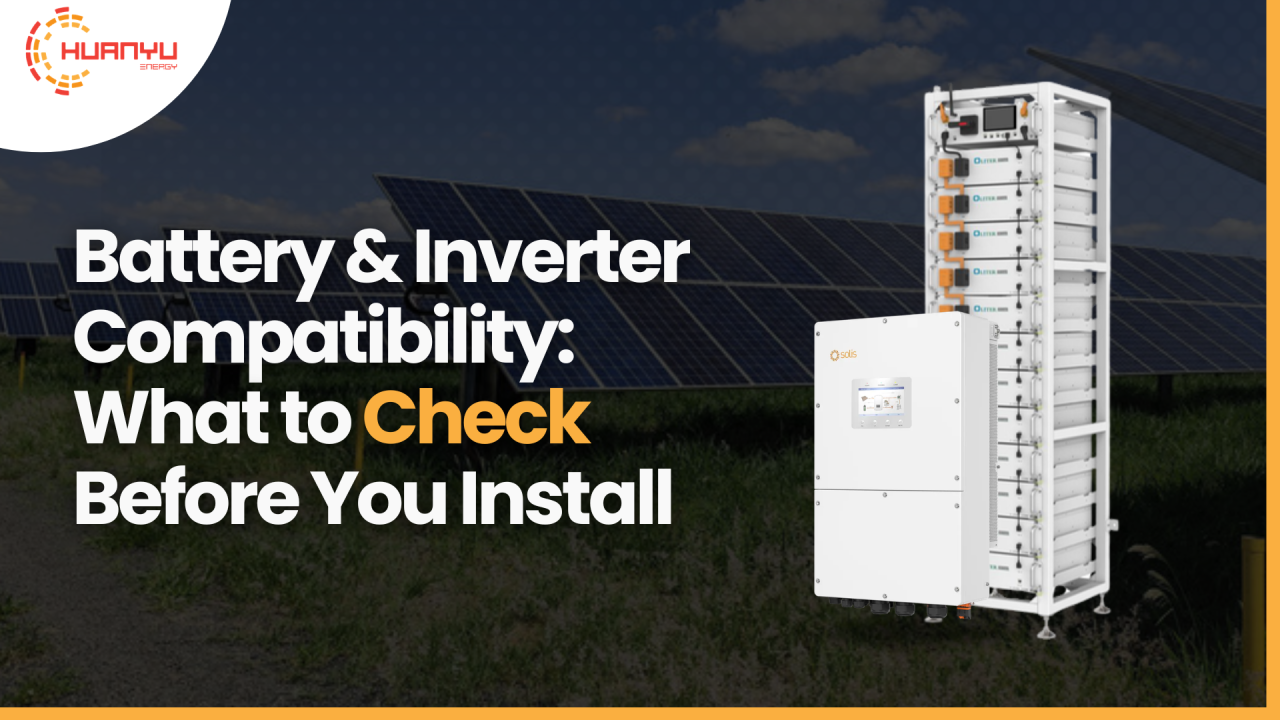
Battery and inverter compatibility is measured in control stability, not startup success. The inverter must manage the battery reliably across fast load changes, PV variability, outages, and thermal conditions. The majority of commissioning delays and repeat callouts are caused by a small group of preventable mismatches: voltage class, communication configuration, and charge/discharge current limits. Get these right first and system behaviour becomes far more predictable.
The non-negotiables
Voltage class must match.
Low-voltage (LV) battery systems are commonly referred to as “48V,” but LiFePO₄ LV batteries are typically around 51.2V nominal (16 cells × 3.2V nominal per cell). High-voltage (HV) battery stacks operate far above that, often hundreds of volts depending on the stack design. An inverter’s battery input range has to match the battery’s operating window if the inverter is built for LV and you bring an HV stack (or vice versa), there’s no “workaround.”
Power (kW) vs energy (kWh) must be checked together.
kWh tells you runtime; kW tells you how much load the battery can actually support at once. A simple fact helps clarify why this matters: Power = Voltage × Current (P = V × I). That means current rises quickly in LV systems as power increases. For example, a 10kW load at roughly 50V is about 200A (10,000W ÷ 50V), while the same 10kW at 400V is about 25A. Higher current increases heat and losses because resistive loss scales with I²R, which is why larger LV systems can become current-heavy and more sensitive to cable sizing, terminations, and settings.
Charge/discharge current limits must line up.
Even if the inverter can push high charge/discharge current, the battery (and its BMS) may not allow it continuously. If the inverter is set to exceed the battery bank’s continuous rating, the BMS will protect itself typically by throttling, alarming, or disconnecting and you’ll see “random” faults that only happen under load, during fast charging, or at certain temperatures. This is one of the most common reasons a system feels unstable despite “compatible” hardware.
Communication and control
Closed-loop control depends on BMS communication.
Modern lithium systems work best when the inverter reads live BMS data (limits, temperature, alarms, SOC) and follows it in real time. Without communication, the inverter falls back to open-loop control, often estimating state of charge from voltage and using generic limits. That’s risky and can be inaccurate, especially with LiFePO₄, which has a relatively flat voltage curve through much of its usable SOC range. In practice, that means a voltage-only estimate can look “fine” right up until the battery suddenly hits a protection threshold under load.
Protocol type is only half the story.
CAN and RS485 are both common, but “it has CAN” doesn’t guarantee it will speak the same battery profile/mapping. You can have a clean physical connection and still have wrong data (or no data) if the protocol profile, pinout, termination, or device addressing is off. The result is usually one of two patterns: the system runs but behaves conservatively (weak discharge/charge), or it runs aggressively until the BMS trips.
Use an approved battery profile when available.
When an inverter has a validated profile for a specific battery model, it typically includes the right limit handling, charge behavior, and protection logic. If you commission manually, be cautious with lithium settings: applying lead-acid habits (like inappropriate float behavior) can keep lithium sitting at high SOC unnecessarily, which may not be ideal for long-term battery health depending on the manufacturer’s guidance.
Protection, firmware, and monitoring
DC protection hardware must be DC-rated.
This one is often overlooked: DC arcs don’t naturally extinguish the way AC does because DC doesn’t cross zero. That’s why isolators, breakers, and fusing must be correctly rated for the system DC voltage and expected fault conditions. Incorrect rating or poor terminations can present as nuisance trips, heat, voltage drop, or intermittent faults that look like “electronics problems” but are actually electrical.
Firmware matters more than people expect.
Battery and inverter manufacturers frequently improve stability, BMS mappings, and fault handling through firmware updates. Two units that “should work together” can still misbehave if one is on older firmware especially around SOC reporting, comms dropouts, or limit interpretation. A disciplined approach helps: confirm recommended versions, update intentionally, and document versions for handover and warranty support.
Monitoring isn’t optional if you want fast troubleshooting. A
A correctly integrated system should show stable SOC, clear charge/discharge limits, meaningful alarms, and consistent data. If monitoring doesn’t show battery data (SOC, power, alarms), you’re effectively commissioning blind and you won’t be able to prove whether the inverter is actually obeying BMS limits when something goes wrong.
Conclusion
To avoid most compatibility issues, stick to the fundamentals you can verify: voltage class, the correct comms/profile, aligned charge and discharge limits, properly rated protection, and monitoring that confirms stable battery data. When those are in place, systems run predictably charging is smoother, BMS events drop, performance under load improves, and callbacks become the exception.
Table of Contents
Toggle