
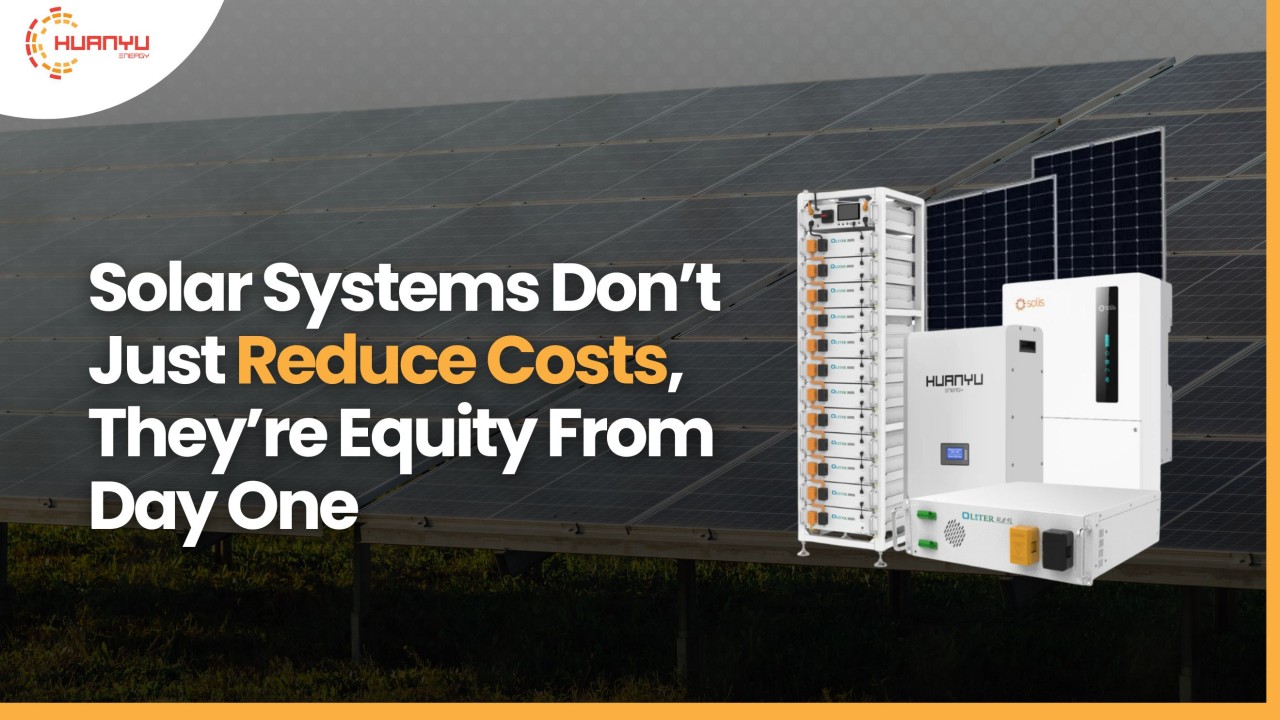
When people talk about solar ROI, the conversation often gets trapped in one narrow metric: monthly utility savings. That’s important, but it’s not the full picture, especially in many African markets where grid constraints, tariff escalation, and downtime risk are part of day-to-day operations. A properly designed solar system isn’t just an “energy saving.” It’s an owned energy asset that starts creating value the moment it is installed and commissioned.
ROI is only half the story
A basic payback calculation usually looks like this:
- How many kilowatt-hours will the PV system produce?
- What does a kilowatt-hour cost today?
- How quickly will tariffs increase?
- How long until savings equal the upfront cost?
That logic is fine but incomplete because it treats solar like a service you “use,” rather than a physical plant you own. From day one, the CAPEX you spend on a solar installation becomes a tangible asset: PV modules, mounting structure, cabling, switchgear, protection devices, inverters, monitoring, and potentially battery storage. Unlike a monthly utility bill (which disappears the moment you pay it), these components remain on site, generating power for years. This shifts the conversation from monthly savings to long-term asset value.

Why “equity from day one” matters in Africa
Across Africa, many energy users face one (or several) of these realities:
- Unstable grid performance (voltage fluctuations, outages, load shedding, constrained supply)
- Diesel dependency for backup power, with volatile fuel costs and high operating expense
- Tariff pressure over time and rising costs tied to demand charges and peak consumption
- Operational downtime risk that is far more expensive than the electricity bill itself
In this environment, solar payback isn’t only about the bill it’s also about risk reduction and operational continuity. If a solar system helps a factory avoid even a handful of production interruptions, or reduces generator runtime meaningfully, the “payback” accelerates in ways a simple kWh spreadsheet won’t show.
The components you install are long-life assets
One reason solar behaves like equity is that the core equipment is designed for long service life:
- PV modules commonly come with long-term performance warranties (often around 25 years, depending on manufacturer and product line).
- Inverters and hybrid inverters typically carry warranties in the 5–10 year range, with many options to extend (again, product- and supplier-dependent).
- LiFePO₄ battery storage (where used) is generally chosen for safety and cycle performance, but real-world lifetime depends heavily on operating window, temperature management, and charge/discharge rates.
The takeaway for project stakeholders is simple: solar hardware is built to keep producing value well after “payback.” The system doesn’t stop being useful once it has paid itself off it continues to generate low-cost energy, often for a decade or two beyond the payback point, if quality components and good EPC practices are followed.
Why many payback conversations under-sell solar
Most “solar payback” discussions miss at least one of these value drivers:
1) Residual value of the asset Even when clients don’t plan to “sell” their system, it still has value as installed infrastructure. For commercial property, owned generation can support improved building attractiveness and operating cost predictability both of which can matter in tenant decisions and longer-term valuation.
2) Avoided downtime and resilience value In many African markets, energy reliability is a business risk. A hybrid system (PV + storage, often with generator integration) can keep critical loads online, protect operations, and reduce the cost and disruption of outages.
3) Diesel reduction If the alternative is heavy generator usage, solar and storage often create measurable savings beyond the utility bill cutting fuel consumption, maintenance cycles, and generator wear.
4) Tariff hedge and planning stability Utilities don’t offer customers a “payback.” Solar does something utilities cannot: it allows a customer to lock in a portion of their energy cost through owned generation and predictable performance.

Financing can still make sense if the design is right
Many customers hesitate because they assume solar must be bought outright to be “worth it.” In reality, financing can work well when system sizing is aligned to a real load profile and the project is designed for consistent output. A useful way to explain it: A utility bill is an expense that never ends. A solar payment (even financed) can behave more like paying for an asset often with a clearer endpoint. In the right tariff and load conditions, clients may see net monthly relief (or near-neutral cost) while the asset is being paid off then a much stronger benefit once it’s paid.
The key is doing the analysis properly: realistic production estimates, conservative assumptions, and a design that matches the site’s operational needs.
Stop waiting for the “next big thing” in solar. It’s already here
Solar isn’t a future technology for Africa, it’s a practical infrastructure decision you can implement right now. Every month a client delays is another month of paying escalating energy costs, absorbing outage risk, and leaning harder on expensive backup power. It’s no surprise solar adoption across Africa has accelerated in recent years: businesses, property owners, and large energy users are choosing proven PV and storage systems to lock in more predictable power costs and strengthen resilience.