
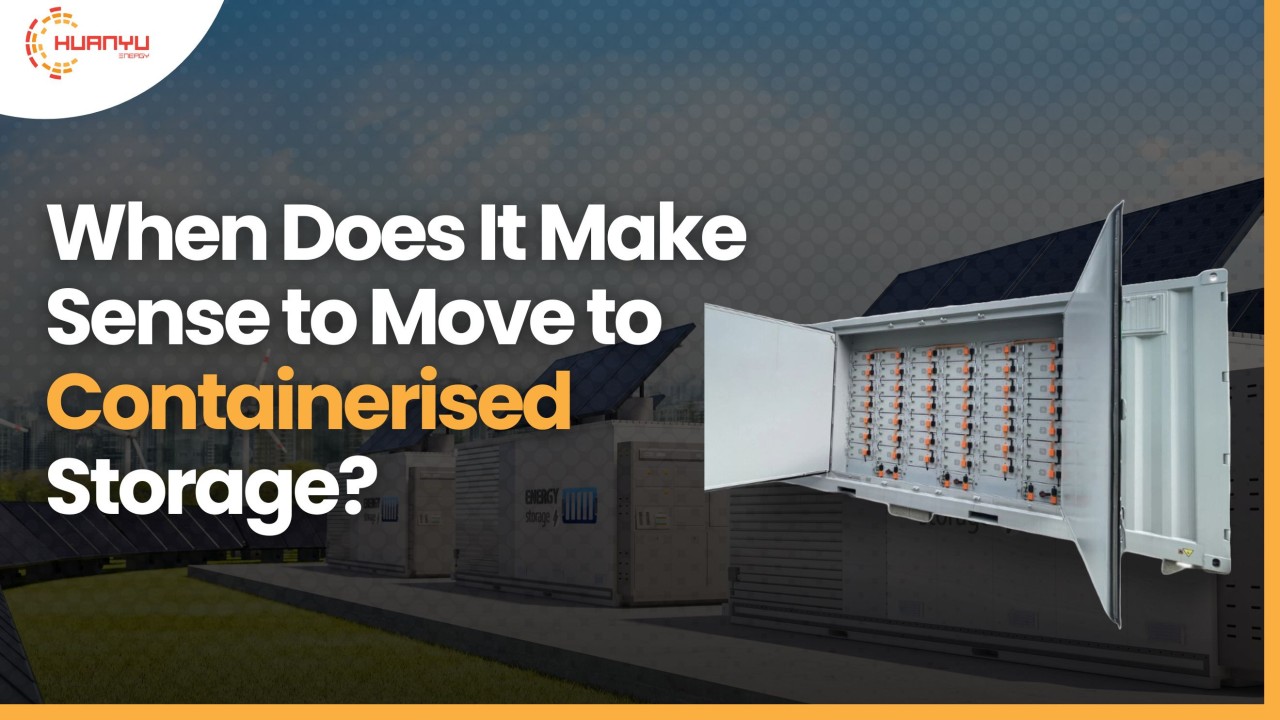
What works well for smaller energy systems does not always scale comfortably as system size and complexity increase. Over time, many businesses, utilities, and large energy users find that traditional battery installations become less practical. In these cases, containerised energy storage systems may offer a more suitable alternative. That said, containerised storage is not always necessary from the beginning. Understanding when it makes sense to make this shift plays an important role in building a cost-effective, scalable, and reliable energy system.
Understanding Containerised Energy Storage
A containerised battery energy storage system integrates batteries, battery management systems (BMS), thermal management, fire protection, and control equipment into a factory-built container, typically in 20-foot or 40-foot ISO formats. These systems are designed to deliver storage capacities ranging from several hundred kilowatt-hours (kWh) to multiple megawatt-hours (MWh) within a single modular unit.
Unlike smaller battery installations that are assembled piece by piece on site, containerised systems are largely pre-engineered, tested, and commissioned before delivery. This approach significantly reduces on-site installation complexity while improving consistency and safety.
When Energy Demand Exceeds Small-Scale Storage
One of the clearest indicators that containerised storage makes sense is scale. Residential and small commercial systems usually operate below 50–100kWh of storage. As soon as energy requirements push into the hundreds of kilowatt-hours or beyond, traditional battery racks become space-intensive and increasingly complex to manage.
For example, a commercial facility with a daily energy consumption of several megawatt-hours may require hundreds of individual battery modules if deployed in small enclosures. Containerised systems consolidate this capacity into a smaller footprint while simplifying cabling, protection, and monitoring. At this scale, containers are often more cost-effective per kWh than distributed battery rooms.
In addition, containerised storage becomes essential when downtime carries a measurable financial or operational cost. Industries such as mining, manufacturing, agriculture, logistics, and data-driven operations depend on continuous power availability. In these environments, energy storage is not just a backup ,it is part of core infrastructure.
Containerised systems are designed with redundancy, controlled operating conditions, and industrial-grade components. Integrated thermal management keeps batteries within optimal temperature ranges, which is proven to improve cycle life and maintain performance stability. This level of reliability is difficult to achieve with fragmented battery installations spread across multiple rooms or buildings.
Harsh or Remote Environments & Expansion
In many parts of Africa, energy projects are located far from stable grid infrastructure. Mines, remote farms, processing plants, and microgrids often operate in high temperatures, dusty conditions, or isolated regions. Containerised energy storage is purpose-built for these realities.
ISO containers provide structural protection against environmental exposure while housing climate control systems that maintain safe battery operating conditions. Because these systems are pre-assembled, they can be deployed quickly in remote locations with minimal on-site work. This makes containerised storage a practical choice for projects where skilled labour or long installation timelines are limited.
Another strong case for containerised storage is future growth. Energy needs rarely remain static. As operations expand, production increases, or electrification deepens, storage capacity must grow alongside demand.
Containerised systems are modular by design. Additional containers can be added in parallel without redesigning the entire system. This scalability allows businesses to start with a manageable capacity and expand as energy usage grows, avoiding large upfront oversizing costs while protecting long-term investment.
When Storage Is Used Beyond Backup Power
Many modern energy systems use batteries for more than load shedding or outage protection. Containerised storage is well suited to advanced applications such as peak shaving, load shifting, renewable energy smoothing, microgrid stabilisation, and hybrid solar-diesel systems.
At higher power and energy levels, these applications require fast response times, precise control, and continuous operation. Containerised systems are designed to handle frequent cycling and high power throughput, making them suitable for these more demanding use cases.
Conclusion
It is equally important to recognise when containerised storage is not necessary. For residential systems, small businesses, or installations with modest backup requirements, wall-mounted or rack-based batteries remain more cost-effective and easier to deploy. Containerised solutions only begin to make sense once scale, reliability requirements, or environmental conditions justify the additional infrastructure. For commercial, industrial, and infrastructure-level projects, containerised storage is not an upgrade, it is often the most logical foundation for reliable, future-ready energy systems.